Views: 0 Author: Site Editor Publish Time: 2026-11-02 Origin: Site
Industrial facilities demand materials built to survive extreme, unforgiving conditions. Standard commercial doors often fail rapidly when exposed to constant moisture, harsh chemical washdowns, and heavy daily impact. Wood Plastic Composite (WPC) blends durable polymers with wood fibers to create a dense, impermeable barrier. Today, facility managers face a relentless battle against rot in hollow-core wood and rust in steel frames. These inevitable material failures compromise sterile zones, create safety hazards, and disrupt critical daily operations.
You need a reliable alternative tailored for high-humidity environments. This guide provides an objective evaluation framework for assessing these advanced composite systems. You will learn how to verify critical structural metrics, ensure strict hygiene compliance, and mitigate common installation risks. We aim to help procurement teams determine if a WPC Waterproof Door truly meets your facility’s operational requirements.
Operational Durability: WPC doors eliminate risks associated with rot, moisture-induced warping, and chemical corrosion.
Maintenance Efficiency: Reduced long-term TCO (Total Cost of Ownership) through zero-painting requirements and easy sanitation.
Critical Evaluation Metrics: How to verify density, fire resistance ratings, and hardware compatibility before procurement.
Implementation Realities: Addressing common misconceptions regarding structural rigidity and installation lead times.
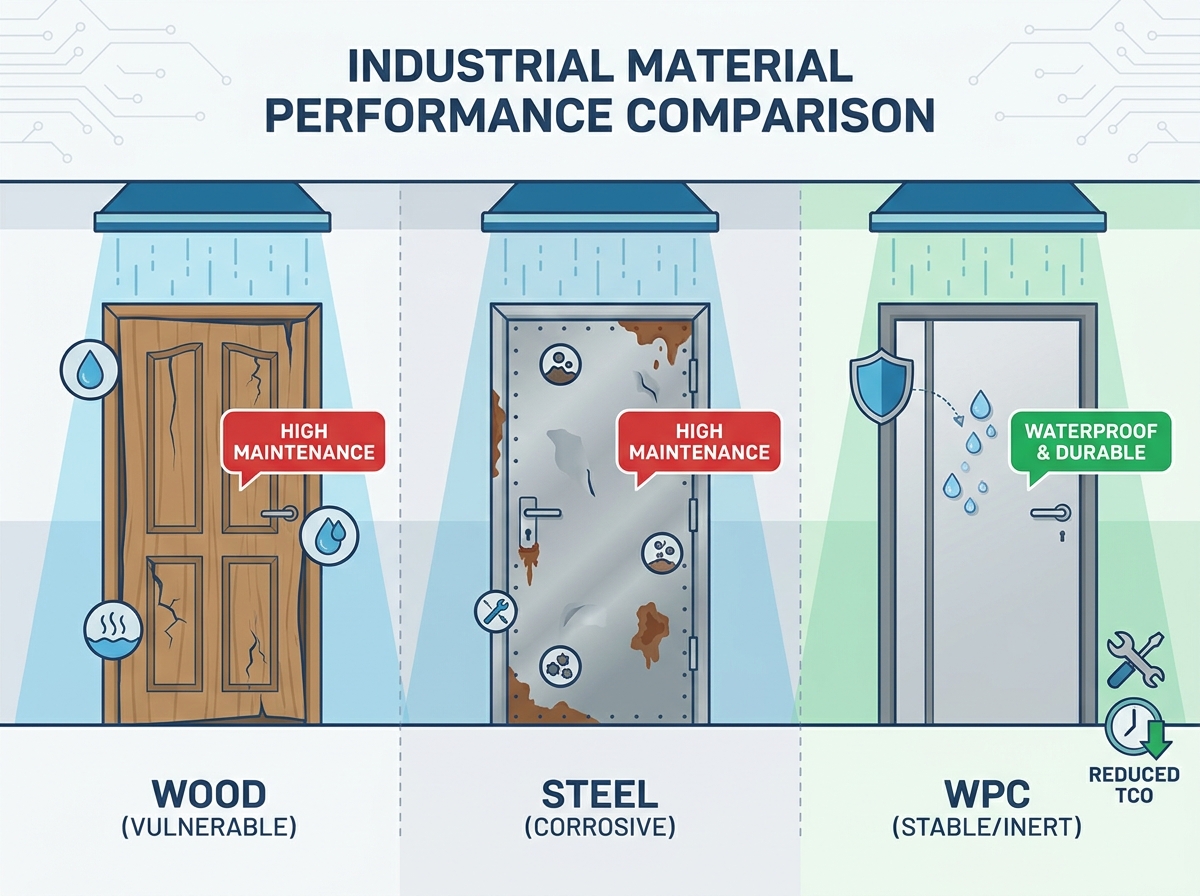
Water destroys traditional facility infrastructure. Hollow-core wood doors act like sponges in high-humidity zones. They absorb ambient moisture, swell within their frames, and eventually delaminate. Steel doors face a different enemy. Daily washdowns in food processing plants accelerate oxidation. Scratches expose raw steel to chemicals, causing rapid rust spread. These vulnerabilities create structural failures. They also harbor bacteria in environments demanding strict sanitation. Facilities need materials that remain entirely inert when wet.
Understanding material behavior helps you make better procurement decisions. The table below outlines how different materials handle extreme industrial stresses.
Material Reliability Comparison in Industrial Zones
Performance Metric | Traditional Wood | Hollow Metal / Steel | WPC (Wood Plastic Composite) |
|---|---|---|---|
Moisture Resistance | Low (Prone to swelling and rot) | Moderate (Prone to rust at seams) | Exceptional (100% Waterproof) |
Impact Tolerance | Moderate (Splinters and cracks) | High (Prone to permanent denting) | High (Absorbs shock, resists denting) |
Chemical Resistance | Poor (Finish strips easily) | Moderate (Corrodes exposed metal) | High (Inert to most cleaning agents) |
Sanitation Profile | Poor (Porous surface traps microbes) | Good (Smooth, but rust traps bacteria) | Excellent (Non-porous, seamless finish) |
WPC excels in specific facility zones. Pharmaceutical labs, commercial kitchens, locker rooms, and aquatic centers benefit immensely from its waterproof nature. The material never rusts, rots, or requires painting. However, WPC is not a universal replacement for heavy-gauge steel. In high-impact loading docks where forklifts operate daily, reinforced steel remains the superior choice. Evaluate your specific zone requirements before selecting a door material.
Best Practice: Map your facility zones by environmental stress. Use WPC in wash-down areas and reserve heavy steel for heavy machinery traffic pathways.
Not all WPC panels share the same quality. The internal core density dictates overall door performance. Low-density formulations feel light but lack structural integrity. High-density cores are critical for hardware retention. They grip mounting screws securely. This prevents hinges from sagging under continuous industrial use. When evaluating products, request density specifications. A heavier door typically indicates a tighter polymer-to-wood-fiber ratio, resulting in superior strength.
Sanitation compliance relies on surface properties. Industrial WPC panels feature a highly engineered, non-porous exterior. Bacteria and mold cannot penetrate the surface. Many manufacturers apply specialized UV-resistant and anti-microbial coatings during extrusion. These finishes withstand aggressive chemical disinfectants without degrading. You can sanitize these surfaces rapidly. This significantly reduces labor hours spent on facility maintenance.
Procurement teams must verify safety certifications. Check fire-rating standards carefully. Reputable WPC products carry UL (Underwriters Laboratories) or EN (European Norm) fire resistance certifications. Additionally, assess environmental compliance. High-quality WPC uses non-toxic adhesives and polymers. They boast low VOC (Volatile Organic Compounds) emissions. They are completely formaldehyde-free. This protects indoor air quality in poorly ventilated industrial zones.
A door is only as strong as its frame and leaf thickness. Standard commercial applications require specific dimensions to withstand repetitive use. Thin panels flex under pressure. Look for reinforced door leaves exceeding standard residential thicknesses. Frame stability matters just as much. The frame must mirror the waterproof properties of the door itself. Installing a waterproof door into a moisture-prone wooden frame defeats the entire purpose.
Common Mistake: Failing to specify WPC frames along with the door leaf. Always procure complete, matching door-and-frame systems to ensure a 100% waterproof barrier.
Labor time heavily influences facility upgrade projects. WPC door systems often utilize adjustable frame designs. These adaptive frames accommodate varying wall thicknesses. Installers save hours during complex retrofits. You can mount them securely over existing rough openings with minimal structural modification. This reduces downtime in active industrial corridors. Quick deployment keeps your operational workflows moving smoothly.
Traditional materials demand continuous upkeep. Wood requires sanding, patching, and repainting. Metal requires rust treatment and dent repair. WPC eliminates these ongoing chores entirely. The color and finish penetrate through the outer layers. Scratches rarely show. You never need to paint these doors. Cleaning crews simply wipe them down with standard industrial detergents. By removing sanding and repainting from your maintenance schedule, you free up facility staff for critical tasks.
Durability dictates replacement cycles. Under standard industrial traffic patterns, high-grade WPC vastly outlasts organic counterparts. Wood doors in wash-down environments may fail within three years. Steel doors in corrosive chemical zones often degrade within five years. A properly installed WPC unit routinely operates flawlessly for over fifteen years. They maintain their dimensional stability despite decades of humidity exposure.
Mounting heavy industrial hardware presents specific challenges. The infamous "screw-pull" risk occurs when heavy door closers rip out of weak composite cores. You must address this during the specification phase. Recommend reinforced mounting points for all heavy-duty hardware. Manufacturers can embed solid polymer blocks or metal plates inside the WPC core. These reinforcements provide secure anchoring for panic bars, magnetic locks, and Grade 1 commercial closers.
Best Practice: Provide your supplier with a complete hardware schedule before manufacturing begins. They will customize the internal blocking to match your exact hardware templates.
You must understand material limitations in high-impact zones. While WPC resists dents better than hollow metal, it cannot survive direct forklift impacts. Facility corridors facing heavy cart traffic require extra protection. Integrate stainless steel kick plates or armor plates on the lower half of the door. Install heavy-duty corner guards on the frames. This hybrid approach combines the waterproof benefits of WPC with the impact resistance of steel.
Extreme temperature shifts affect composite materials. WPC expands and contracts slightly under severe thermal stress. Consider environments transitioning directly from a sub-zero cold storage unit to a heated production floor. Installers must account for thermal tolerances. Leave appropriate expansion gaps between the door leaf and the frame. Use flexible, high-grade weatherstripping to maintain seals while allowing for natural material movement.
Never rely solely on marketing brochures. Demand comprehensive Technical Data Sheets (TDS) from potential suppliers. Scrutinize specific engineering metrics.
Modulus of Rupture (MOR): This indicates the bending strength of the panel under load. Higher MOR means better structural rigidity.
Water Absorption Rate: This must sit as close to 0% as possible. A true waterproof product will not absorb moisture during prolonged submersion tests.
Screw Holding Capacity: Look for specific force ratings (measured in Newtons) proving the core can support heavy industrial hardware.
Physical inspection prevents costly procurement errors. Request cross-section sample pieces before placing bulk orders. Inspect the internal core visually. It should look dense, uniform, and free of large air pockets. A fragmented or crumbly core indicates poor manufacturing controls. High-quality WPC feels heavy and solid in your hand.
Read the warranty documentation carefully. Suppliers often separate cosmetic warranties from structural guarantees. A warranty might cover color fading for two years but guarantee against structural rot for ten years. Ensure the warranty explicitly covers industrial, high-humidity usage. Discard suppliers who void their warranties simply because the door undergoes daily chemical cleaning.
Upgrading facility infrastructure requires precision and foresight. WPC doors represent a highly specialized asset engineered for aggressive environmental challenges. They thrive where water, humidity, and harsh sanitation protocols destroy traditional materials. However, they are not a universal replacement for heavy steel in pure impact zones.
To successfully integrate these systems, take the following actionable next steps:
Audit your facility to identify current door failure hotspots, specifically prioritizing areas with visible rot or rust.
Map your chemical wash-down zones and classify them for immediate WPC replacement.
Request customized hardware blocking diagrams from suppliers to guarantee heavy closer compatibility.
Demand physical cross-section samples to verify core density before initiating your full-scale procurement process.
A: Yes, provided they feature specialized outdoor-grade formulations. Standard WPC can fade under direct sunlight. For exterior use, specify doors treated with heavy UV inhibitors. These protect the structural integrity and prevent color degradation caused by long-term solar exposure.
A: Absolutely. However, automated operators exert significant rotational force on the door leaf. You must specify internal reinforcements during the ordering process. The manufacturer will embed high-density polymer or metal blocking at the precise mounting points to support automated arms securely.
A: WPC provides excellent acoustic performance, often rivaling solid wood. The high-density extruded core naturally absorbs and blocks sound waves. When paired with high-quality acoustic perimeter seals, WPC systems easily meet strict noise reduction requirements for industrial offices and laboratories.
A: Standard sizes usually ship within standard supply chain windows (often 2-4 weeks). Customized configurations requiring internal blocking for specialized hardware or non-standard dimensions typically add 3-5 weeks to the lead time. Always factor these manufacturing adjustments into your project schedule.