Views: 0 Author: Site Editor Publish Time: 2026-11-04 Origin: Site
Commercial facilities face accelerated wear-and-tear daily. Heavy traffic damages standard materials rapidly. Moisture exposure ruins ordinary doors quickly. Hotels, hospitals, and multifamily housing need tougher interior solutions. Wood Plastic Composite (WPC) technology bridges a vital gap here. It combines natural wood aesthetics beautifully. It also delivers incredible synthetic endurance. Decision-makers must evaluate these materials carefully. You should compare WPC against traditional options. Review upfront pricing, installation realities, and operational longevity thoroughly. A smart investment prevents future budget drains. Understand the actual performance metrics before committing commercial procurement budgets. This guide reveals the facts behind WPC investments. We explore durability, financial returns, and implementation risks. Facility managers will learn how to optimize their procurement strategy effectively.
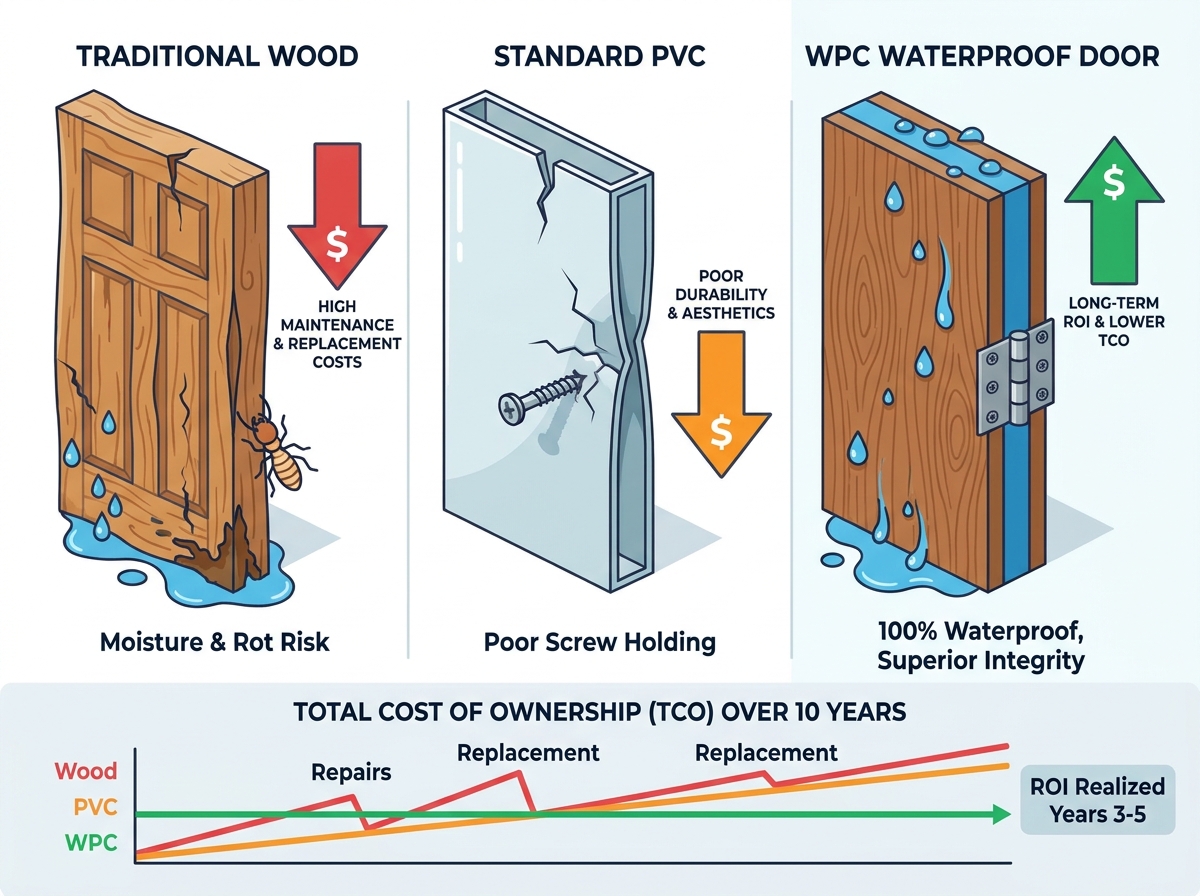
A WPC waterproof door eliminates moisture-induced swelling, termite damage, and frequent repainting costs, lowering maintenance overhead.
While upfront costs for WPC are typically 15–20% higher than basic PVC, their lifespan in high-traffic or damp environments extends significantly further, improving long-term ROI.
WPC provides superior screw-holding capacity and structural integrity compared to standard PVC, but requires specific installation protocols to manage its heavier weight.
Businesses must verify vendor compliance regarding fire ratings, environmental certifications, and hardware compatibility before scaling a facility-wide rollout.
Standard doors fail prematurely in specific zones. Restrooms experience constant humidity spikes. Basements harbor damp air continuously. Exterior-facing commercial entryways face relentless weather shifts. High-humidity climates accelerate material decay drastically. Ordinary wood absorbs this ambient moisture. Standard synthetic doors warp under temperature changes. You must identify these vulnerable areas early. Installing standard products here guarantees premature failure. Facility budgets drain quickly from constant replacements.
Defining what constitutes a successful commercial door investment is crucial. Zero moisture absorption stands as the primary metric. Resistance to chemical cleaning agents matters immensely. Hospitals and hotels use harsh disinfectants daily. These chemicals degrade standard paint fast. Structural stability under heavy daily cycles is non-negotiable. Commercial doors swing open hundreds of times daily. Flimsy materials break down under this sheer volume. A successful investment withstands these brutal conditions effortlessly.
We must view this through a skeptical lens. You do not strictly need WPC for every interior office. Dry, low-traffic areas function fine using basic hollow-core doors. Premium materials belong where environments demand them most. A standard boardroom door rarely faces harsh moisture. Save your procurement budget here. Allocate premium funds toward high-risk facility zones instead. Wet environments justify this upgraded investment completely. Smart procurement targets specific environmental threats directly.
To audit your facility effectively, consider these high-risk zones:
Commercial Restrooms: Steam and splashed water destroy wooden frames rapidly.
Locker Rooms: High ambient humidity causes traditional materials to swell.
Basement Corridors: Poor ventilation traps dampness constantly.
Cafeteria Kitchens: Spills and frequent chemical cleanings degrade normal finishes.
Facility managers often struggle choosing between material types. Understanding structural differences prevents costly procurement mistakes. The core composition dictates long-term performance completely. Wood offers beauty but lacks environmental endurance. PVC offers water resistance but lacks physical strength. WPC blends the best traits of both worlds. It engineers away the inherent weaknesses of traditional options. Let us examine these differences closely.
Material Performance Comparison Summary
Feature | Solid Wood | Traditional PVC | WPC |
|---|---|---|---|
Moisture Resistance | Low (Absorbs water) | High (Waterproof) | Exceptional (100% Waterproof) |
Impact Strength | High | Low (Prone to cracking) | High (Solid core design) |
Termite Threat | High Risk | Zero Risk | Zero Risk |
Maintenance Needs | High (Sealing, painting) | Low (Wipe clean) | Low (Wipe clean) |
Moisture and biological threats destroy solid wood constantly. Wood naturally absorbs ambient humidity from the air. This absorption leads to severe warping over time. Swollen doors stick inside their frames stubbornly. Rot eventually takes hold in damp environments. Termites also target wooden structures aggressively. These pests cause catastrophic unseen damage. WPC remains biologically inert. It is 100% waterproof by design. Pests ignore it completely. It never swells or shrinks.
The maintenance burden separates these materials drastically. Wood requires frequent periodic sealing. You must varnish wooden surfaces regularly. Scratches demand immediate sanding and repainting. This labor costs facilities thousands annually. A WPC Waterproof Door eliminates these tedious chores entirely. It requires only standard surface cleaning. Housekeeping teams simply wipe it down. You never need specialized wood treatments again.
Durability and impact resistance define commercial viability. PVC feels incredibly lightweight. It cracks easily under accidental impact. Rolling carts puncture hollow PVC surfaces often. Furthermore, PVC degrades rapidly under UV light. It becomes brittle and discolored quickly. WPC blends real wood fibers and tough polymers. This creates a solid, impact-resistant core. It withstands heavy blows easily. It survives hospital cart collisions without cracking.
Aesthetic appeal and hardware compatibility matter greatly. PVC looks distinctly plastic. It feels cheap to the touch. Hollow PVC holds screws very poorly. Heavy hinges rip out over time. WPC mimics natural wood grain beautifully. It feels premium and substantial. It maintains high screw-holding capacity safely. Commercial-grade hinges stay firmly attached. Door closers operate smoothly without pulling screws loose. You achieve luxury aesthetics alongside industrial durability.
Budgeting requires looking beyond initial purchase prices. We must examine the baseline cost variables objectively. Compare the initial unit pricing carefully. WPC costs more upfront than standard hollow PVC. It often prices similarly to commercial-grade solid core wood. Purchasing departments sometimes hesitate at this premium. However, buying cheap doors guarantees future spending. You simply defer the real costs. Let us break down the true financial impact.
The lifespan estimation model reveals the real story. Map out the expected lifecycle for each material. Wood installed in damp areas rots quickly. It forces a rigid 5-year replacement cycle. Hollow PVC cracks and fails within similar timeframes. Conversely, WPC lasts 15 years or more. It survives harsh environments relentlessly. You buy three wooden doors over a fifteen-year period. You buy one WPC door for that exact same timeframe.
Hidden maintenance variables destroy facility budgets quietly. Calculate the saved labor costs carefully. Calculate the saved material costs too. You avoid repainting cycles entirely. You eliminate costly rot repair completely. Pest control treatments become unnecessary. Calculate these savings over a 10-year facility horizon. The numbers favor engineered composites heavily. Labor hours spent fixing sticking doors vanish. Maintenance teams focus on critical infrastructure instead.
Here are common maintenance traps you avoid:
Sanding down swollen door edges during summer months.
Hiring exterminators for termite infestations.
Replacing stripped screws in hollow plastic frames.
Buying specialized varnishes and wood sealants annually.
The ROI verdict becomes transparently clear quickly. ROI arrives between year three and five. Avoided replacement costs drive this return heavily. Eliminated maintenance labor secures the remaining financial gap. If you manage a large hotel, this multiplies exponentially. Upgrading hundreds of units saves massive operational capital. It is a mathematically sound business decision.
Procuring superior materials solves only half the puzzle. Installation determines actual field performance heavily. Weight considerations demand immediate attention. WPC products weigh significantly more than alternatives. They surpass hollow PVC easily. They weigh more than standard composite doors. This mass provides incredible acoustic and impact benefits. However, it requires serious handling protocols. Installers must anticipate this heft during the hanging process.
Hardware anchoring requires careful planning. Outline the necessity for heavy-duty commercial hinges clearly. Three standard hinges rarely support this weight adequately. We recommend four commercial-grade ball-bearing hinges per slab. Existing door frames need strict evaluation during retrofits. They must bear the heavy load perfectly. Weak frames will cause severe sagging over time. Reinforce older wooden frames before hanging new heavy slabs.
Installation caveats plague unaccustomed contractors frequently. Address the risk of improper hanging upfront. Inexperienced workers often misjudge the necessary clearances. They might use inadequate residential screws. This ruins the installation immediately. We highly recommend utilizing WPC-specific frames. These matching frames provide optimal load distribution reliably. They also ensure a uniform aesthetic finish. Properly matched frames prevent structural failure completely.
Best practices for commercial installations include:
Pre-drilling holes: Always pre-drill pilot holes for heavy-duty hinges.
Verifying plumb walls: Ensure the rough opening is perfectly level.
Using long anchors: Drive anchor screws deep into the structural wall studs.
Testing swing paths: Check the door closer tension immediately after hanging.
Selecting the right manufacturing partner protects your investment. You must verify essential certifications vigorously. Environmental compliance standards protect indoor air quality. Request documents showing low VOC emissions explicitly. Ensure they utilize eco-friendly materials responsibly. Regional fire safety ratings represent a major hurdle. Standard composite materials often lack fire resistance natively. You must verify commercial fire-rated status carefully. Manufacturers often add specific chemical retardants to achieve this. Ask for official third-party testing certificates.
Scalability checks prevent construction delays. Can the manufacturer supply uniform batches reliably? High-volume commercial rollouts demand massive inventory output. Small factories struggle producing consistent colors across large batches. Verify their production capacity before signing purchase orders. Ask about their quality control checkpoints. A mismatched wood grain ruins hallway aesthetics instantly. Consistency across five hundred units proves their manufacturing maturity.
Warranty assumptions trap careless buyers frequently. Read every commercial warranty exceptionally closely. Look for hidden exclusions regarding hardware modifications. Some warranties void if you install third-party closers. Check for specific UV exposure clauses too. Non-standard climates might void exterior usage claims. Understand exactly what constitutes a valid defect. Reputable vendors offer straightforward warranties transparently. They stand behind their engineering without hiding behind dense legal jargon.
Watch out for these common vendor red flags:
Refusal to provide physical cross-section samples.
Lack of certified acoustic rating data.
Vague warranty terms regarding moisture exposure.
Inability to produce recent commercial case studies.
Upgrading your commercial facility requires strategic material selection. The final decision matrix points toward engineered durability clearly. Standard materials fail under constant moisture and heavy traffic. They generate unacceptable maintenance overhead continually. If your facility struggles against these elements, upgrade your approach. A WPC investment solves these operational headaches mathematically. It stabilizes your long-term maintenance budgets effectively.
Your next steps require decisive action. Advise your procurement team to request sample cross-sections today. Audit your facility physically to identify specific problem zones. Demand hardware pull-out test data from prospective suppliers immediately. Compare vendor warranties side-by-side. Make your procurement decisions based on proven engineering facts. Stop replacing the same failed wooden doors repeatedly. Upgrade your facility infrastructure intelligently.
A: Yes, they accept customization readily. Manufacturers apply specialized surface treatments and laminations easily. You can order exact color matches for corporate branding. While the material requires no painting for protection, it accepts polyurethane-based paints well. However, factory-applied laminates usually provide superior scratch resistance compared to post-installation painting.
A: They handle moisture perfectly, making them excellent for damp environments. However, exterior suitability depends on specific UV resistance variables. Direct, relentless sunlight can cause surface fading if unshielded. Ensure the manufacturer includes UV-inhibiting additives in the exterior-grade core to maintain long-term temperature stability and color.
A: Yes, they provide excellent acoustic performance. The solid wood-polymer core offers high acoustic density. This mass blocks sound transmission much better than standard hollow PVC or cheap wooden doors. Hotels and confidential offices benefit greatly from this inherent sound-dampening quality.
A: Custom bulk orders typically require six to ten weeks. Manufacturing custom sizes and specific finishes takes time. Freight shipping from large facilities adds several weeks. Set realistic expectations for your construction timeline. Always order well in advance of your required on-site delivery dates.