Views: 0 Author: Site Editor Publish Time: 2026-11-03 Origin: Site
High-moisture environments pose a relentless challenge for property developers and homeowners. Bathrooms, basements, coastal properties, and commercial kitchens rapidly degrade standard interior doors. These harsh conditions quickly turn beautiful installations into maintenance nightmares. Constant moisture exposure directly leads to swelling, veneer delamination, and costly premature replacements. Choosing the wrong material significantly increases your long-term financial burden through continuous upkeep and inevitable structural failure. You cannot afford to replace doors every few years just because they get wet.
We need an objective, side-by-side evaluation to navigate this architectural challenge effectively. This comprehensive guide evaluates how a WPC Waterproof Door performs against traditional materials like solid wood, UPVC, and engineered wood. You will discover exactly how these options compare across durability, aesthetic appeal, and real-world implementation constraints. By the end, you will have the exact knowledge needed to select the optimal door material for any high-humidity project.
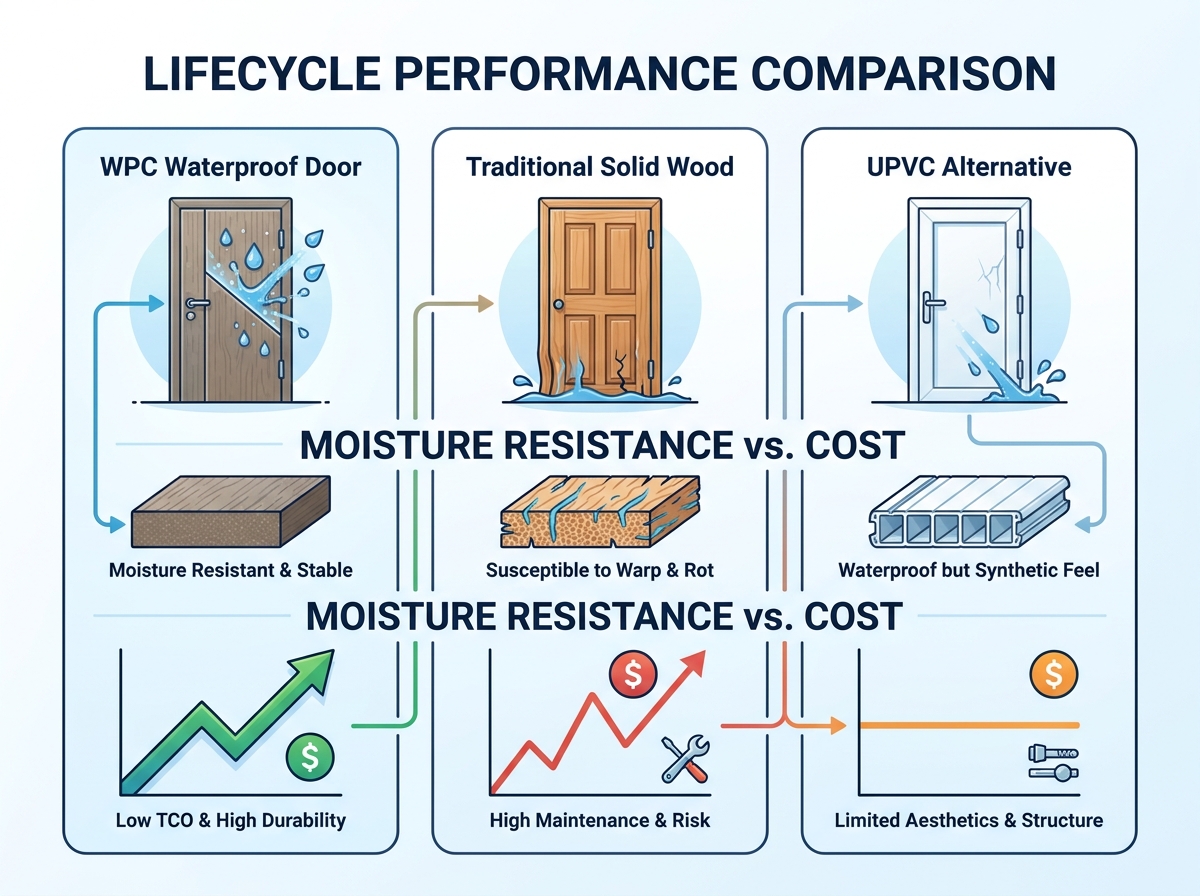
WPC (Wood Plastic Composite) offers the highest structural stability in 100% moisture environments, permanently eliminating warping and rot.
Traditional Solid Wood remains the standard for high-end aesthetic authenticity and structural rigidity but requires strict climate control and ongoing sealing.
UPVC competes with WPC on water resistance but falls short on aesthetic versatility, screw-holding capacity, and overall structural feel.
The Decision Driver: WPC presents a higher upfront material cost than hollow-core or basic UPVC options, but delivers a substantially lower 10-year lifecycle cost in wet or high-humidity applications.
Before comparing performance metrics, we must define what makes a door successful in wet areas. A viable wet-area door must perform three tasks flawlessly. First, it must resist moisture absorption completely. Second, it must hold standard architectural hardware securely over thousands of usage cycles. Third, it must match the aesthetic requirements of the broader property. If a material fails even one of these criteria, it becomes a liability.
The market generally offers four primary material choices for interior and utility doors. Understanding their core composition reveals why they behave differently under stress.
WPC Waterproof Doors: Manufacturers extrude these doors from a precise blend of fine wood fibers and thermoplastic polymers. This hybrid approach is intentional. It provides the easy workability of natural wood combined with the inert, water-repelling properties of plastic.
Solid Wood: This is the traditional gold standard for premium construction. Builders prize solid wood for its weight, rigidity, and natural beauty. However, wood is inherently hygroscopic. It naturally absorbs and releases moisture from the surrounding air.
Engineered Wood (MDF/HDF): These doors use compressed wood fibers bound with resins. They are highly customizable and cost-effective. Unfortunately, they act like sponges when exposed to direct water.
UPVC (Unplasticized Polyvinyl Chloride): This is a plastic-based alternative. You often see UPVC in budget housing or strictly utilitarian wet-area applications. It is lightweight and ignores water, but it carries a highly synthetic, glossy appearance.
Materials behave differently when moving from a controlled factory into a humid, real-world environment. We evaluate these materials across three distinct performance pillars.
Moisture is the primary enemy of interior doors. A bathroom door faces daily steam. A basement door battles constant ambient humidity. How materials react to this moisture determines their lifespan.
WPC excels in this category. It typically absorbs less than 1% moisture even when fully submerged. The plastic polymers encapsulate the wood fibers, creating an impenetrable barrier. A WPC waterproof door will not swell, delaminate, or warp under direct water exposure. You can install it in a commercial kitchen or a wet-room bathroom without fear of extreme humidity fluctuations.
Traditional and engineered woods struggle here. They are highly susceptible to seasonal expansion and contraction. During humid summers, wood absorbs ambient moisture and expands. This causes the door to bind or stick in its frame. Without rigorous, ongoing maintenance, wood carries a high risk of bottom-edge rot. Veneers will eventually peel as the underlying glues degrade.
UPVC is technically 100% waterproof. Water cannot penetrate the plastic surface. However, UPVC faces a different stability issue. It is prone to thermal expansion. Extreme temperature shifts can cause UPVC frames to warp. In very cold environments, the plastic can become brittle and crack under impact.
A waterproof door is useless if the hinges rip out after a few months of heavy use. Hardware compatibility dictates how well a door integrates into a standard building project.
WPC offers excellent structural integrity. Its high density allows carpenters to use standard woodworking tools. You can cut, rout, and drill it exactly like timber. It holds screws very effectively. Standard door handles and residential hinges install without issue. However, experienced installers note a caveat for heavy commercial use. If you plan to install heavy-duty commercial surface closers, you may need factory-reinforced stiles to handle the extreme localized tension.
Traditional solid wood remains the undisputed champion for structural rigidity. Its dense, fibrous nature provides exceptional screw-holding capacity. This makes solid timber ideal for heavy commercial hardware, panic bars, and massive mortise locks.
UPVC falls drastically short in this category. Hollow plastic profiles possess incredibly weak screw-holding capacity. You cannot simply screw a standard hinge into a UPVC slab. UPVC systems typically require proprietary hardware. Alternatively, they require extensive internal metal reinforcement (usually steel or aluminum) during the manufacturing process. This severely limits your aftermarket hardware choices.
Designers refuse to compromise on aesthetics simply to gain water resistance. The chosen material must blend seamlessly with the interior decor of the property.
WPC provides exceptional aesthetic versatility. Manufacturers can seamlessly wrap WPC slabs in high-quality PVC decorative film. They can also paint the surface or press it with realistic textures to mimic natural wood grain. When finished properly, WPC offers a premium, substantial feel that closely mirrors solid painted wood. Guests in a luxury hotel often cannot tell the difference.
Traditional wood offers unmatched natural beauty. Nothing artificially replicates the authentic grain variations of real oak, mahogany, or walnut. Wood allows for premium staining capabilities. Designers can achieve deep, rich tones that highlight the natural character of the timber.
UPVC severely restricts your design options. You are largely limited to basic extrusion colors, which are predominantly white or beige. UPVC carries a distinct, shiny plastic look. Furthermore, you cannot easily paint or refinish a UPVC door. As aesthetic trends change over a decade, a UPVC door remains permanently stuck in its original color.
Material Performance in High-Moisture Environments
Material Type | Moisture Resistance | Screw-Holding Capacity | Aesthetic Flexibility |
|---|---|---|---|
WPC | Excellent (< 1% absorption) | High (Standard tools work) | High (Paint, wrap, texture) |
Solid Wood | Poor (Prone to rot/swelling) | Exceptional | Exceptional (Stains beautifully) |
Engineered Wood | Very Poor (Swells instantly) | Moderate | High (Excellent for painting) |
UPVC | Excellent (100% waterproof) | Low (Requires reinforcement) | Low (Hard to paint) |
Evaluating building materials strictly on their initial price tag is a dangerous trap. Real value emerges when you analyze the complete lifecycle of the product. This includes acquisition, installation overhead, and ongoing maintenance.
First, consider upfront acquisition costs. Engineered wood and basic UPVC doors represent the lowest initial investment. They are budget-friendly at the checkout counter. WPC sits in the mid-to-high tier. It costs more than basic hollow-core doors but remains highly competitive. Premium solid wood sits at the absolute highest price tier, especially for hardwoods.
Next, we must factor in installation overhead. Labor costs can quickly ruin a project budget. WPC installs exactly like traditional wood. Carpenters use the exact same saws, routers, and screws. This means no specialized labor is required. There is no learning curve for your framing crew. In contrast, UPVC often requires proprietary framing systems and specialized installation techniques, which drives up labor costs.
The true financial divergence happens in maintenance and lifecycle expenses. Traditional wood generates high ongoing costs in wet areas. You must regularly sand, repaint, and reseal it. If a wooden frame warps due to moisture, you must pay labor to remove it and install a replacement. WPC requires near-zero maintenance. You simply wipe it clean. It does not rot. It does not require periodic chemical treatments to fend off termites. You never need to apply sealants to block moisture.
The ROI verdict is clear. For standard, dry interior rooms like bedrooms, engineered wood remains highly cost-effective. However, for bathrooms, basements, and exterior-facing utility rooms, upgrading to WPC is the smartest financial move. It typically yields a positive return on investment within the first 3 to 5 years. You achieve this simply by completely avoiding the first costly cycle of repair or replacement.
Every building material has unique handling requirements. Moving from traditional timber to composite materials introduces specific implementation realities. Installers must adapt their practices to ensure long-term success.
Weight considerations are paramount. Solid WPC doors are significantly heavy. Their dense composite core mimics the mass of solid hardwood. Installers cannot cut corners on hanging hardware. You must use heavy-duty ball-bearing hinges. We recommend a minimum of three hinges per leaf for standard heights, and four for oversized doors. Using cheap residential hinges will inevitably cause the frame to sag under the door's weight over time.
Adhesive compatibility is another common stumbling block. Sometimes contractors want to apply custom veneers or edge banding to a door post-purchase. You cannot use standard PVA wood glues on WPC. The plastic polymers in the material prevent water-based glues from penetrating and bonding. Installers must use polyurethane-based (PUR) adhesives specifically designed for composite materials. These adhesives cure through a chemical reaction, creating an unbreakable bond on non-porous surfaces.
Finally, consider thermal constraints. WPC handles water flawlessly, but extreme heat requires careful planning. Darker-colored WPC doors absorb significant solar radiation. If you install a dark WPC door in an exterior-facing application with direct, sustained UV heat, the surface will experience intense heat buildup. Without a proper structural overhang to provide shade, extreme surface temperatures can cause the thermoplastic elements to expand or warp slightly. Always use lighter colors or provide adequate shading for exterior applications.
Material selection rarely relies on a single metric. The best choice depends entirely on the specific environmental risks and aesthetic goals of your project. Use the following logic to shortlist the winning material.
Choose WPC When: The primary environmental risk is moisture or termites, but the design demands premium aesthetics. If your project requires the substantial physical feel and hardware compatibility of a traditional wooden door, WPC is the ideal choice. Common applications include luxury hotel bathrooms, coastal residential projects exposed to salt air, and hospital wet rooms requiring frequent deep cleaning.
Choose Solid Wood When: The door lives in a strictly climate-controlled environment. If your budget comfortably accommodates premium natural aesthetics, timber shines. Furthermore, if you are working on a historical renovation where architectural heritage legally mandates the use of real timber, you must choose solid wood and accept the ongoing maintenance requirements.
Choose UPVC When: The project is strictly utility-focused. If the budget is tightly constrained and aesthetic matching with the surrounding interior decor is not a priority, UPVC serves well. It works adequately for hidden basement storage rooms or temporary utilitarian structures where visual appeal matters least.
Evaluating doors strictly on their upfront purchase cost often obscures the severe long-term liabilities of moisture damage. Water will inevitably exploit the weaknesses in hygroscopic materials, leading to swelling, peeling, and expensive premature replacements. Choosing the right material from day one protects both your project budget and your property's value.
While traditional solid wood absolutely maintains its rightful place in controlled, heritage environments, modern composites have shifted the industry paradigm. WPC waterproof doors have successfully engineered the risk out of high-humidity applications. They deliver total peace of mind against rot and warping without forcing designers to sacrifice a premium architectural feel.
Next Steps:
Audit the specific moisture-exposure levels of your required doorways. Identify which rooms lack adequate ventilation.
Request physical WPC cross-section samples directly from manufacturers.
Test the sample's density and screw-holding capacity against your current hardware specifications to ensure complete compatibility.
A: Yes, WPC can be easily cut, planed, and routed using standard woodworking tools. However, you must consider the internal extrusion structure. If the door has a tubular or hollow core structure rather than a solid core, there are strict limits to how much you can trim from the edges. Over-trimming will expose the hollow internal cavities, compromising the door's integrity.
A: For maximum moisture protection, you should ideally pair WPC doors with matching WPC frames (often called chaukhats). Hanging a completely waterproof door inside a traditional wooden frame creates a weak link. The wooden frame remains highly susceptible to ambient moisture and ground-level rot, which ultimately undermines your investment in the waterproof slab.
A: Unlike raw wood, WPC does not absorb moisture, so it does not strictly require a primer for sealing purposes. However, the smooth plastic-blend surface can resist standard household paints. If you choose to paint it for aesthetic reasons, you must lightly scuff the surface and apply a high-quality PU (Polyurethane) or epoxy-based paint to ensure proper, long-lasting surface adhesion.
A: WPC materials inherently possess better flame-retardant properties compared to untreated raw wood, and they are often self-extinguishing. However, standard WPC extrusions do not automatically meet commercial fire codes. If your building codes require a strict 30, 60, or 90-minute fire rating, you must specifically source a certified fire-rated WPC door from the manufacturer.