


Read a WPC door dimensional stability test by checking the method, specimen scope, exposure conditions and measured dimensional change before any pass/fail headline. If the report is only a plastics water-absorption test, treat it as material evidence, not proof that a complete door will remain flat in service.

Start with the test method, not the marketing headline
The first line to read is the standard or method named in the report, because a door-climate method and a material water-absorption method answer different buyer questions.
For door-leaf behaviour between different climates, look for EN 1121 or a national adoption such as NF EN 1121. The AFNOR listing for NF EN 1121 describes testing door leaves and door blocks between two climates and lists the standard as current.
| Report wording | What it can help you judge | What it does not prove by itself |
|---|---|---|
| EN 1121 or NF EN 1121 | Behaviour of a door leaf or door block between two climates | A specific WPC door result unless the specimen, model and measured values match your purchase file |
| ASTM D570-22 | Relative water absorption of plastics when immersed, including moisture-related dimensional effects | Whole-door flatness, frame fit, hardware alignment or installation tolerance |
Do not approve a WPC Moisture-Proof Door from the title alone. Record the method, edition, specimen and result before comparing suppliers.
Match the specimen to the door component you are buying
A dimensional stability result is useful only when the specimen matches what you are buying: material sample, door leaf, door block, frame or doorset.
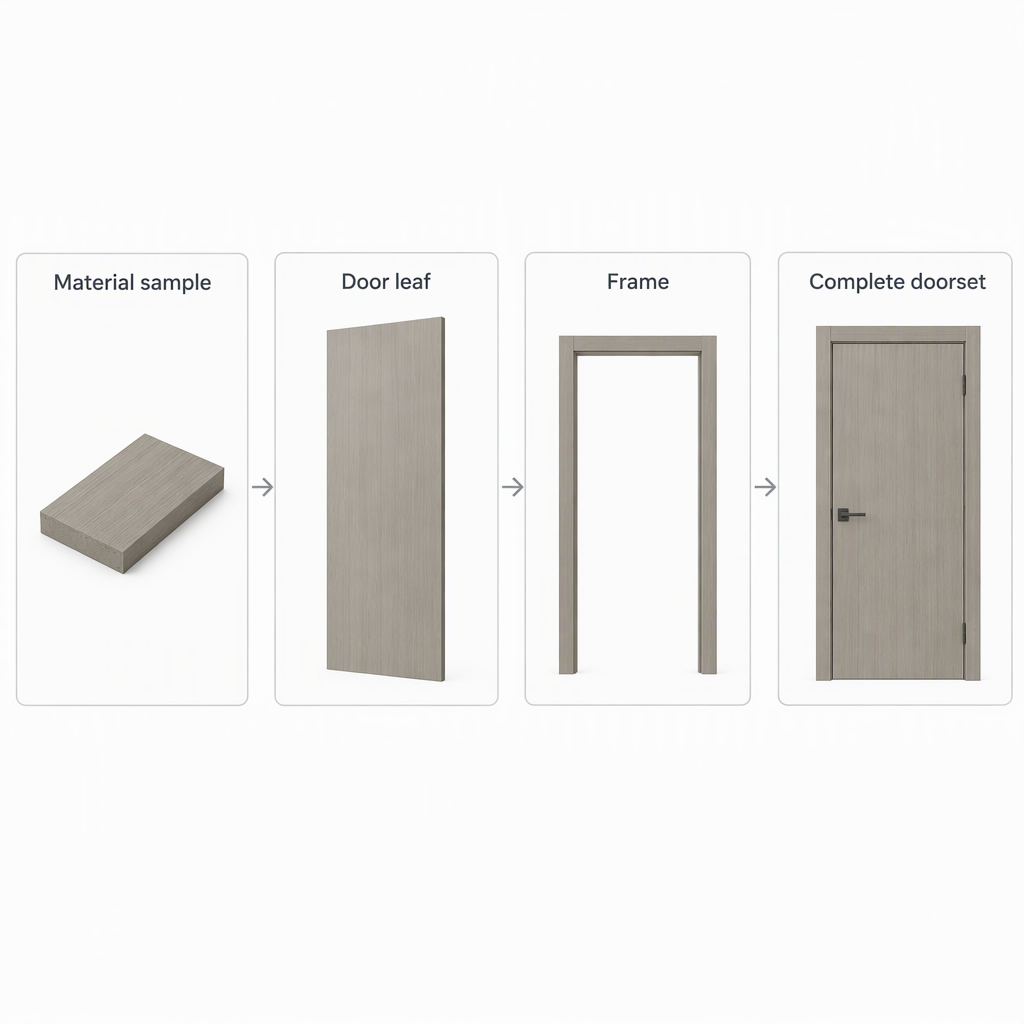
| Specimen shown in the report | Buyer use | Extra proof to request |
|---|---|---|
| Material coupon or plastic sample | Screen the material’s moisture absorption behaviour | Door-leaf dimensional stability data and the exact WPC door model mapping |
| Door leaf | Assess whether the leaf stayed within the reported dimensional or warpage result under the stated climates | Frame, hinge, lock and opening-size compatibility in mm |
| Door block or doorset | Assess a broader assembly under the report’s stated conditions | Confirmation that the frame, seal, hardware and threshold match your project configuration |
| Frame or accessory only | Check one component’s suitability | A separate door-leaf or doorset report before making flatness claims |
Keep door-leaf dimensions, door-frame dimensions and rough-opening dimensions separate. Record all sizes in millimetres, and do not convert a leaf test into an opening-fit promise.
Follow a step-by-step reading sequence
Read the report in a fixed order: method, specimen, conditioning, exposure, measurement points, result and model match.
- Identify the method name and edition. If the report uses EN 1121 or NF EN 1121, treat it as a door leaf or door block climate-behaviour method, then check whether the report names the same scope.
- Copy the specimen identity: model code, construction, thickness, leaf size, frame inclusion and hardware inclusion. Use mm.
- Separate pre-test conditioning from the actual test exposure. A humidity, climate or immersion condition matters only as far as the report defines it.
- Find the measurement locations. Door-leaf bow, twist, edge movement and width or height change are not interchangeable measurements.
- Read the numerical result and the acceptance statement together. A pass statement without the measured value is weaker for project comparison.
- Match the report to the purchase item. The finish, core, thickness, leaf size and frame should match the planned door.
- Report number and laboratory name are present.
- Specimen type is clear: material, leaf, block, frame or doorset.
- Door-leaf size, frame size and opening size are not mixed.
- Climate, humidity, water exposure or immersion is stated.
- Result units are readable, preferably mm for movement.
- The supplier can link the tested specimen to the quoted WPC door model.
Separate material water absorption from door-leaf dimensional stability
A water-absorption percentage can support a material discussion, but it does not replace a door-leaf warpage or dimensional stability test.
The ASTM D570-22 listing identifies the method as an active standard test method for water absorption of plastics, covering relative water absorption when plastics are immersed and noting moisture-related effects on properties including dimensions.
| Evidence type | Good buying question | Limit |
|---|---|---|
| Plastics water absorption test | How does the WPC material respond to immersion under the stated method? | It does not show hinge-side twist, latch clearance or frame interaction. |
| Door leaf climate test | How did the leaf behave between two different climates? | It does not automatically cover a different size, finish, frame or hardware set. |
| Installation record | Will the leaf fit the actual frame and opening? | It is not a laboratory dimensional stability result. |
Use material testing for moisture response and door-leaf or door-block testing for dimensional behaviour; if only one is provided, keep the claim to that scope.
Apply the result to damp-room decisions without overclaiming
A WPC door dimensional stability test can help screen doors for damp interior spaces, but the door selection does not replace moisture control in the building.
In damp interiors, first identify the moisture source. The EPA moisture-control guidance explains that moisture can come from leaks, seepage, indoor activities or condensation, and control may require repairs, ventilation, dehumidification or air conditioning.
- If the issue is condensation, combine product selection with condensation control and ventilation.
- If the issue is leakage or seepage, address the water entry before relying on a door specification.
- For splash-prone interiors, compare the report’s exposure condition with the actual service condition.
- For apartment projects, ask whether the quoted leaf, frame and finish are the same configuration as the tested specimen.
Do not describe an interior moisture-proof door as solving continuous immersion, active leakage or unresolved dampness without direct evidence for that condition.
Ask the supplier for the missing proof before approval
Before you approve a WPC door for a damp-space project, ask for the complete report package and a written link between the report and the quoted model.
- Which test method and edition were used?
- Was the specimen a material sample, door leaf, door block, frame or complete doorset?
- What were the leaf dimensions in mm, and were frame and opening dimensions listed separately?
- What climate, humidity, immersion or water-exposure condition was applied?
- Where were dimensional change, bow, twist or warpage measured?
- What was the measured value, not just the pass/fail statement?
- Which finish, thickness, hardware preparation and frame configuration were tested?
- How does the report number map to the exact quotation line item?
For a project submittal, attach the supplier’s report package to your purchase record rather than relying on a catalogue phrase alone.
Keep model claims tied to the exact report
Use the supplier’s product page, certificate page and quotation as navigation aids, but make the approval decision from the exact report and specimen match.
If you are comparing a listed WPC door model, ask the supplier to identify the current product page, the relevant certificate or report file, and the quotation item that corresponds to the tested specimen. The claim should name the model, leaf size in mm, test method, report number and result scope.
Avoid statements such as “all WPC doors will not warp” or “the door solves basement moisture.” A safer buying sentence is: “This quoted configuration is supported by report number X under method Y for specimen Z and condition W.”
Conclusion
The correct buying rule is to approve the claim only as far as the method, specimen and conditions actually support it.
- Use EN 1121 or NF EN 1121 evidence for door leaf or door block climate behaviour only within the stated specimen scope.
- Use ASTM D570-type evidence for plastics water absorption only within the material-test scope.
- Use moisture-control guidance to separate door selection from leak, seepage, ventilation and condensation problems.
FAQs
These buyer questions help you turn a WPC door test report into a safer specification decision.
What should I read first in a WPC door dimensional stability test?
Read the method, specimen and exposure condition first. The result is meaningful only after you know what was tested and under which conditions.
Is EN 1121 relevant to door leaf warpage?
It is relevant when the report uses it for the behaviour of a door leaf or door block between two different climates. Then you still need the specimen identity and measured result.
Does ASTM D570 prove a WPC door will stay flat?
No. ASTM D570-22 concerns water absorption of plastics. It can support a material moisture discussion, but it does not prove complete door-leaf stability.
Why separate door leaf, frame and opening dimensions?
The door leaf is the moving panel, the frame is the installed surround, and the opening is the building aperture. Mixing these dimensions can cause the wrong fit decision.
Can a WPC moisture-proof door solve a damp room?
It can be part of a damp-space selection, but leaks, seepage, condensation and ventilation problems still need building moisture control.
What should I ask the supplier before placing an order?
Ask for the report number, method, specimen description, dimensions in mm, exposure conditions, measured result and written mapping to the quoted WPC door model.


