Views: 0 Author: Site Editor Publish Time: 2026-11-06 Origin: Site
High-moisture environments like bathrooms expose traditional doors to rapid degradation. This constant humidity often results in severe warping, insidious rot, and frustrating structural failures. Wood Plastic Composite (WPC) has emerged as the industry standard for these wet areas. However, actual performance varies drastically based on structural density, extrusion methods, and applied surface treatments. Relying solely on appearance can lead to premature failure in demanding bathroom conditions. Selecting the right WPC Waterproof Door requires looking past basic aesthetic appeal. You must comprehensively evaluate core structural integrity, hardware compatibility, and material compliance. In this guide, we will explore how to assess material composition and distinguish between solid and hollow cores. You will also learn how to identify crucial hardware requirements and navigate safety standards to ensure long-term durability.
Not all WPC doors are equal; structural density and the ratio of thermoplastic to wood flour dictate the door’s actual water resistance and lifespan.
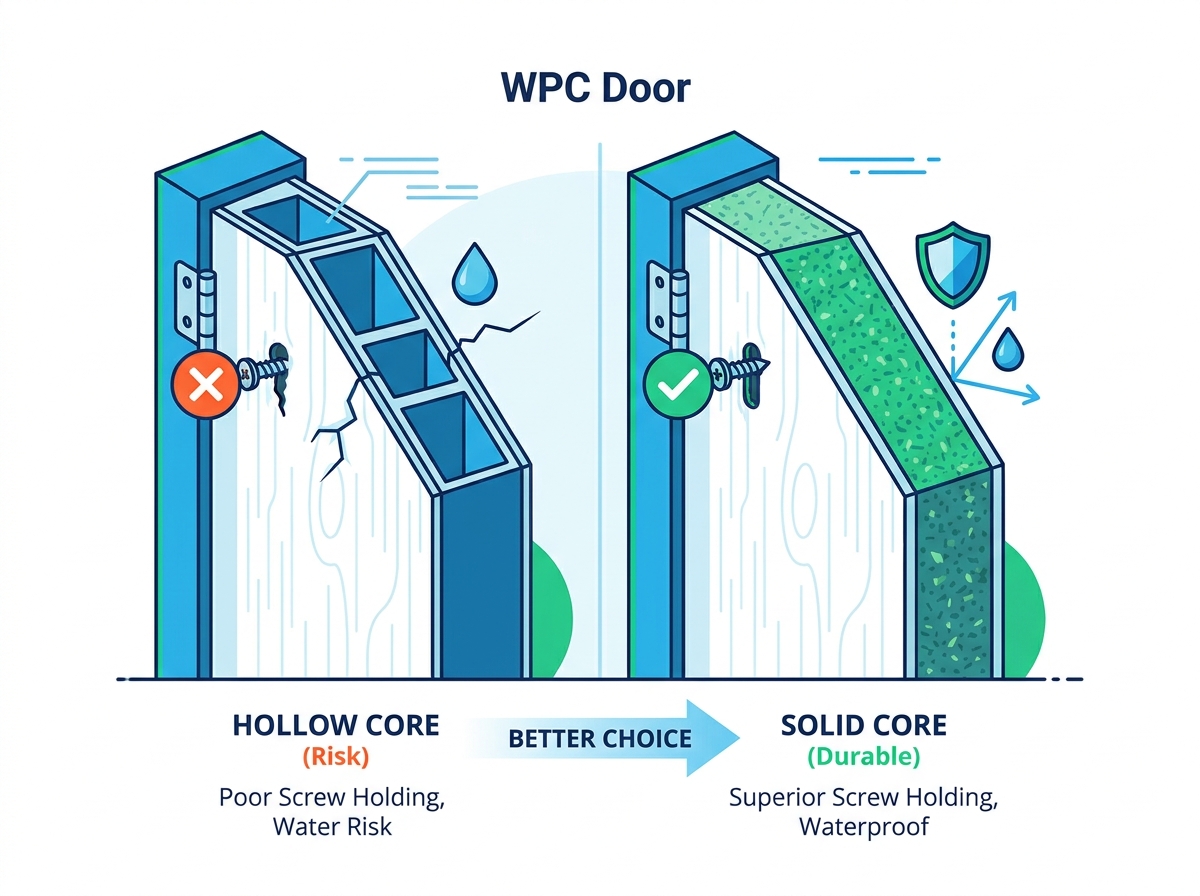
Hollow-core WPC doors lower upfront costs but often fail at hinge points due to poor screw-holding capacity.
Surface treatments (PVC film lamination vs. PU painting) significantly impact both the moisture barrier and visual integration with surrounding architecture.
Evaluating supplier compliance with environmental (VOC/formaldehyde) and fire-retardancy standards is critical for commercial and residential safety.
Bathrooms represent the harshest interior environment in any building. Daily showers generate thick steam and persistent condensation. This moisture settles heavily on every exposed surface. Traditional wooden doors simply cannot survive these relentless conditions over time. Medium-Density Fiberboard (MDF) acts exactly like a sponge. It absorbs ambient moisture rapidly through microscopic surface pores. This aggressive hygroscopic expansion causes jammed frames, peeling paint, and eventual functional failure. Solid wood faces similar, albeit slower, challenges. It warps when exposed to constantly fluctuating humidity levels. The natural wood fibers swell and contract unevenly. This constant movement creates deep structural rot. You eventually face unavoidable and disruptive replacement cycles.
A WPC Waterproof Door solves these inherent material flaws permanently. Wood Plastic Composite combines two distinct, powerful materials. It blends the structural workability and aesthetic warmth of wood fibers. It then adds the completely impervious nature of modern thermoplastics. Manufacturers typically use high-grade Polyvinyl Chloride (PVC) for this polymer base. This unique combination blocks water penetration completely at a molecular level.
We must compare WPC directly against other common wet-area alternatives. Unplasticized Polyvinyl Chloride (UPVC) doors are entirely waterproof. However, they possess a distinct, artificial plastic sheen. They often feel flimsy and sound hollow when closed. WPC offers far superior aesthetic customization. It closely mimics the heavy, satisfying feel of traditional timber doors. You can route, cut, and finish it exactly like standard wood. It integrates seamlessly into luxury interior designs.
Solid wood remains a popular choice for high-end interiors. Yet, it carries significant moisture risks in wet zones. WPC eliminates the threat of termite and insect infestation entirely. The plastic matrix offers no nutritional value to pests. It also stops moisture-induced warping completely. You get a dimensionally stable, highly predictable door for demanding bathroom projects.
Evaluating these doors requires looking deeply beneath the surface. You must analyze specific manufacturing metrics to ensure long-lasting quality.
The precise wood-to-polymer ratio dictates practical performance. A standard, high-quality composite mix contains roughly 60% fine wood flour. It uses 30% virgin PVC resin to bind the fibers securely. The remaining 10% consists of highly specialized chemical additives. These essential compounds include UV stabilizers, foaming agents, and colorants. A higher polymer content generally increases waterproofing capabilities. The plastic encases the wood fibers more thoroughly. However, excessive plastic can negatively affect panel rigidity. It makes the door susceptible to thermal bending under heat.
You must also rigorously assess overall board density. Manufacturers measure this metric in kilograms per cubic meter (kg/m³). Low-density doors are highly problematic for daily use. They lack sufficient internal mass to hold screws. They are prone to sagging on their hinges over time. They also suffer from impact damage easily, showing dents from minor knocks. Always request technical data sheets confirming precise density specifications before purchasing. A premium door feels substantial and heavy in your hands.
The internal architecture varies significantly between different manufacturer models. This hidden structure determines both durability and specific application suitability.
Hollow core designs are very cost-effective for tight budgets. They feature an extruded internal grid containing empty air pockets. They are lightweight and remarkably easy for solo contractors to install. However, they offer minimal acoustic insulation between rooms. Bathrooms often require better soundproofing for basic privacy. Furthermore, hollow cores pose very high risks for hardware failure. The thin external walls cannot grip metal screws effectively. Frequent usage pulls the hinges loose quickly.
Solid or semi-solid core doors require a higher upfront investment. They utilize tubular core designs or fully solid extrusion profiles. They provide the necessary structural integrity for heavy, continuous use. They deliver vastly superior soundproofing for residential and commercial bathrooms. Most importantly, they offer highly reliable anchor points. Heavy hardware, door closers, and specialized hinges mount securely without tearing the composite.
Solid vs. Hollow Core Structural Comparison
Feature | Hollow Core WPC | Solid / Semi-Solid Core WPC |
|---|---|---|
Weight | Lightweight | Heavy (similar to solid timber) |
Acoustic Insulation | Poor to Moderate | Excellent |
Hardware Retention | Weak (requires internal reinforcement) | Strong and highly reliable |
Impact Resistance | Susceptible to denting | Highly durable against blunt impacts |
Raw WPC possesses a dull, industrial appearance. It requires a protective and highly aesthetic outer layer. The specific application method of this layer matters immensely.
PVC film wrapping is a highly popular surface treatment globally. It offers endless textures, ranging from matte colors to realistic wood grains. Manufacturers must apply this film using Polyurethane Reactive (PUR) adhesive. PUR glue cures through a complex chemical reaction involving ambient moisture. It creates an unbreakable, highly heat-resistant bond. Lower-grade hot-melt adhesives will fail inevitably in steamy environments. The steam reactivates the cheap glue, causing immediate edge peeling. Once the edge peels, the visual aesthetic is ruined forever.
Painted finishes offer a sleek, seamless, modern appearance. They eliminate the risk of edge banding delamination entirely. Evaluate the specific use of UV or Polyurethane (PU) paints. Bathroom temperatures fluctuate rapidly during hot showers. The applied paint must remain highly elastic. It must handle these minor thermal shifts without stress. Brittle paint formulations will develop severe micro-cracking over time. These microscopic fissures allow moisture ingress, potentially destroying the door substrate from within.
Even the highest-quality door will fail if contractors install it improperly. Hardware and framing choices are critical, non-negotiable success factors.
The single most common failure point for any WPC Waterproof Door is hinge sag. Composite materials behave very differently than raw natural timber. They lack the long, interlocking grain structures of wood. Ensure your chosen door features heavily reinforced stiles. Some premium manufacturers insert raw timber or high-density plastic blocks here. This provides a dense zone specifically for hinge mounting. Alternatively, specify sufficient overall board density across the entire panel. The composite material must grip standard mounting screws securely under tension.
Common Mistake: Installers often use standard coarse-thread wood screws out of habit. These aggressive threads can strip the internal polymer matrix easily. Always use proper pilot holes and appropriately threaded machine or composite fasteners.
Many experienced contractors make a critical, project-ruining framing error. They install a composite waterproof door panel into a standard MDF frame. This completely defeats the purpose of your entire investment. The MDF frame rests directly on the bathroom floor. It will absorb surface water and ambient moisture from the tiles. It will eventually swell, rot, and compromise the door alignment entirely. The door frame and all surrounding architraves must also be extruded WPC. This holistic approach ensures a 100% moisture-proof barrier across the entire architectural opening.
Persistent bathroom humidity destroys standard zinc-plated hardware incredibly rapidly. Steam and condensation settle heavily on hinges and locksets daily. Rust develops within months.
Follow these strict hardware selection steps for wet environments:
Specify marine-grade stainless steel components exclusively for all moving parts.
Choose grade 304 stainless steel for standard, well-ventilated residential bathrooms.
Opt for grade 316 stainless steel in coastal environments or high-traffic commercial shower rooms.
Verify that internal lock mechanisms feature rust-resistant brass or stainless interior parts.
Avoid powder-coated hardware completely unless the underlying base metal is certified rust-proof.
Building codes and safety regulations apply strictly to interior architectural doors. You must verify supplier compliance across several crucial safety categories.
Indoor air quality is absolutely paramount for both residential and commercial projects. Many traditional composite building materials rely on heavy, toxic chemical binders. You must verify the specific manufacturing process and all applied adhesives. They must meet stringent E0 or E1 international indoor air quality standards. E0 signifies virtually zero detectable formaldehyde emissions. E1 represents safe, heavily regulated, and internationally accepted emission levels. Never accept verbal confirmations from sales representatives. Always request independent, third-party laboratory testing certificates before ordering.
Local safety regulations often dictate strict fire performance metrics for building materials. WPC is inherently much more flame-retardant than standard raw wood. The high chlorine content naturally present in PVC suppresses open flames effectively. However, base materials alone do not guarantee legal compliance. Request official B1-level fire-resistance certifications from your supplier. This is especially critical for commercial spaces or multi-family residential building projects. B1 classification ensures the door material is extremely difficult to ignite. It will also self-extinguish rapidly when the primary flame source disappears.
Specialized architectural environments demand significantly higher hygiene standards. Healthcare facilities, gymnasiums, and hospitality bathroom projects require extra microbial protection. Warm, consistently damp bathrooms breed mold and dangerous bacteria very quickly. Verify if anti-fungal or anti-bacterial chemical additives exist directly in the polymer mix. Silver-ion technology represents a common, highly effective additive utilized today. It prevents microbial growth directly on the physical door surface. This specialized treatment ensures a safer, notably cleaner environment for all facility users.
Selecting a reliable supplier requires rigorous, analytical vetting. You must look far beyond glossy marketing brochures and aggressive sales pitches. Evaluate tangible, physical quality indicators to protect your bathroom project.
Current market prices provide highly valuable, immediate quality indicators. You should routinely reject quotes sitting significantly below the established market average. These so-called "bargains" always hide severe, unacceptable manufacturing compromises. They typically indicate ultra-thin internal extrusion walls to save material costs. Unscrupulous suppliers might use recycled, low-grade plastics instead of robust virgin resins. They may also substitute high-performance PUR glue for cheap, unreliable hot-melt adhesives. These critically compromised doors will inevitably fail within two years of installation.
Best Practice: Compare at least three highly detailed supplier quotes. Ensure they list the exact same density, surface lamination type, and core structural profile.
Never place a massive bulk order based solely on digital photos. You must demand physical, representative cross-section samples from shortlisted factories. Use these physical samples to meticulously inspect internal manufacturing quality.
Execute the following sample testing protocol:
Examine the outer wall thickness carefully with digital calipers.
Inspect the internal ribbing structure for absolute uniformity and straightness.
Test the lamination adhesion strength manually by aggressively picking at the sharp edges.
Submerge the entire sample piece in a bucket of water for 48 hours.
High-quality manufacturing samples will resist edge peeling completely. They will show absolute zero dimensional swelling or warping after prolonged water immersion.
A manufacturer's official warranty clearly reveals their internal confidence in the product. Suspiciously short warranties heavily suggest anticipated, premature material failure. Look aggressively for manufacturers offering minimum five-to-ten-year comprehensive warranties. Read the attached fine print incredibly carefully. The official warranty must specifically cover moisture-induced expansion. It should explicitly and legally protect you against structural rot and surface delamination in bathroom settings.
Sourcing a truly reliable composite waterproof door is a demanding exercise. It requires perfectly balancing high structural density, appropriate surface treatments, and matching framing systems. You cannot compromise on these core elements without risking premature failure. Prioritize semi-solid or high-density hollow core doors for maximum longevity. Ensure they feature PUR-bonded PVC lamination or high-elasticity polyurethane paint. This strategic approach effectively mitigates the most common, frustrating adoption risks. You will avoid sudden hinge failure and unsightly edge peeling entirely. Your immediate next action is clear. Define your specific project's acoustic, structural, and aesthetic requirements. Then, request physical cross-section samples and detailed technical data sheets from your shortlisted suppliers to conduct rigorous comparative testing.
A: Yes, the core composite material itself is entirely impervious to water. It will not absorb moisture or rot. However, if surface lamination peels due to poor adhesive quality, water can degrade the door's aesthetic finish rapidly. The core remains structurally intact, but the door becomes visually unacceptable.
A: High-density or solid-core models hold screws exceptionally well, performing similarly to hardwood. Conversely, cheaper, thin-walled hollow variants lack sufficient material density. They often require specialized plastic anchors or factory-reinforced stiles. Without these reinforcements, heavy doors will experience severe hinge sag over time.
A: You can paint them, but the process requires specific bonding primers designed exclusively for plastics and PVC. Standard wood paint will peel off quickly. Furthermore, factory-laminated doors are extremely difficult to refinish successfully once the protective PVC film sustains deep scratches or damage.
A: A premium-quality model can easily exceed 15 to 20 years of continuous service. It will not rot, swell, or warp. To achieve this lifespan, you must install it utilizing appropriate marine-grade stainless-steel hardware and matching extruded composite frames.